RTA vs Custom Cabinets: The Cost Gap Explained
The gap between a stock cabinet and a custom one is not a single markup; it is a set of small decisions that each add cost. CasaBuilt's four six-cabinet starter kitchens run from $1,230.69 in Navy Blue Shaker to $2,295.64 in Slim White Oak, a spread of $1,064.95 inside one catalog. Understanding where that spread comes from is the fastest way to see where a custom quote starts to climb.
Key takeaways
- A basic six-cabinet kitchen ranges from $1,230.69 to $2,295.64 across four published styles.
- The published box is 1/2-inch birch plywood with a solid birch face frame across the line.
- Stock widths stop at 42 inches for bases and 39 inches for wall cabinets, which is where custom work begins.
- Finish and current discount explain more of the price gap than the carcass does.
Where a custom quote accumulates cost
A custom cabinet is priced from a drawing rather than from a catalog page. Someone has to measure the room, draw the unit, set up a saw for a width that no standard door fits, and spray a finish to match a sample. Each of those steps is skilled labor applied to one kitchen, and none of it is shared with the next order. That is the structural reason a custom quote is higher, before any question of materials.
Stock cabinetry spreads the same work across many identical units. The door is cut on a fixed program, the finish is applied in a batch, and the price list can be printed. CasaBuilt's model adds a second saving by selling direct, with no showroom overhead and no hidden upgrade pricing, and it publishes the result as a sale price beside a struck-through list price.
The distinction matters when comparing quotes. A custom quote and a stock quote rarely describe the same cabinet, so the useful comparison is not the total at the bottom but the list of parts and operations that produced it. If the custom quote includes a corner built to an offset that no stock width can fill, part of the gap is buying a fit that stock cabinets cannot deliver.
Where the stock ladder stops
Stock widths are a ladder, and the ladder has ends. Base cabinets run from 9 to 42 inches in twelve published sizes, wall cabinets from 9 to 39 inches in heights of 30, 36 and 42 inches, and vanities from 12 to 48 inches at 21 inches deep. Almost every straight run can be filled from that list without a filler panel, which is why so many kitchens never need a custom box.
The exceptions are specific. A wall that ends 4 inches short of a standard combination, a chimney breast that pushes a run out of square, a sink that needs a cabinet wider than the ladder allows, or a bank of drawers that has to line up exactly with a window above it. Those are the moments where custom pricing earns its place, and they are worth identifying before the quote conversation rather than during it.
There is also the question of what fills the gap when the ladder stops one size short. A filler panel closes the space and costs little. A custom cabinet closes the space and costs a great deal more. The difference between the two is often a design decision about where the run starts, not a difference in quality. CasaBuilt lists the whole range as rta cabinets in fixed widths, and that fixed ladder is the honest boundary of the product.
The construction line does not move much
Buyers often assume the price gap tracks the carcass. It does not, at least not inside one catalog. The published box is 1/2-inch birch plywood with a natural birch interior, the face frame is 3/4-inch by 1-1/2-inch solid birch, the door is a rubberwood frame with an MDF panel, hinges are concealed soft-close units adjustable in six directions, glides are soft-close undermount with full extension, and drawers are 5/8-inch rubberwood with dovetail joints. The finish is seven layers of paint with a UV protective topcoat.
That specification is published for the line rather than for one premium style, which is why the jump from $1,230.69 to $2,295.64 does not come with a thicker box or a different hinge. What changes is the door finish and the discount attached to that style: 50% off list on Navy Blue, 20% off on Smokey Ash, Slim Aston Green and Slim White Oak. Every door carries seven layers of paint under a UV protective topcoat, which is where much of the door price sits. The door profiles themselves are worth a look before the quote conversation, and the Shaker collection is where most kitchens start.
Custom work can add to the construction, and often does: a thicker panel, a different door profile, a hand-applied finish. Those upgrades are real, and they are also priced individually. The point is that a stock cabinet is not automatically a cheaper box. In this line it is the same box at a different door price.
| Style | Sale price | List price | Discount | Per cabinet |
|---|---|---|---|---|
| Navy Blue Shaker | $1,230.69 | $2,461.37 | 50% | $205.12 |
| Smokey Ash Shaker | $1,932.42 | $2,415.52 | 20% | $322.07 |
| Slim Aston Green Shaker | $2,148.28 | $2,685.36 | 20% | $358.05 |
| Slim White Oak | $2,295.64 | $2,869.56 | 20% | $382.61 |
The discount column is the one that moves most. Navy Blue sits at half list, which puts a painted cabinet below a mid-range custom door long before any labor is counted. The three 20% styles cost more because their finish and door work cost more, not because the carcass changed.
Worked example: measuring the gap inside one catalog
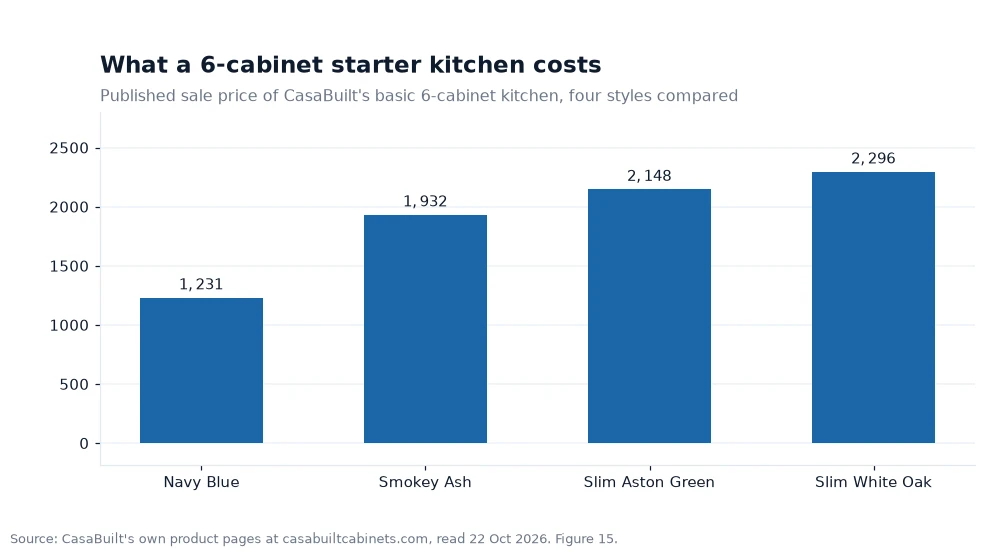
The chart plots the same six-cabinet bundle in four styles: Navy Blue at $1,230.69, Smokey Ash at $1,932.42, Slim Aston Green at $2,148.28 and Slim White Oak at $2,295.64. Divide each by six cabinets to compare like with like. Navy Blue is $205.12 per cabinet, Smokey Ash is $322.07, Slim Aston Green is $358.05 and Slim White Oak is $382.61.
The full spread is $2,295.64 minus $1,230.69, or $1,064.95 for the same six cabinet positions. As a ratio, $2,295.64 divided by $1,230.69 is 1.865, so the most expensive style costs 86.5% more than the cheapest. On a per-cabinet basis the step from Navy Blue to Slim White Oak is $177.49, which is the size of a finish decision made once and paid for six times.
Put the spread in units of something else you will buy anyway. At $9.99 per sample, $1,064.95 buys 106 samples with $6.01 left over. It is also more than the $1,000 gap between a $1,500 order and the $2,500 free-shipping threshold. A custom quote that closes a small gap in a run sits in the same order of magnitude as choosing the top of the catalog, which is why the layout decision deserves the same attention as the finish.
Frequently asked questions
Is a stock cabinet built worse than a custom one?
Not by default. The published specification here is a 1/2-inch birch plywood box, a 3/4-inch by 1-1/2-inch solid birch face frame, soft-close concealed hinges, full-extension undermount glides, dovetail drawers and a seven-layer painted finish. Custom work can exceed that specification, but it has to be specified to do so, and the upgrade should appear as a line on the quote.
Why does Slim White Oak cost more than Navy Blue?
Two published reasons. The discount differs, at 20% off list for the oak-look line against 50% off for Navy Blue. And the finish work differs, which is what the door price reflects. The box and frame specification is published as the same across the line, so the gap is not a thicker carcass.
When does a custom cabinet make sense?
When the room cannot be built from standard widths without an awkward filler, or when the design depends on a dimension the catalog does not make. A chimney breast, an out-of-square wall or a run that must end exactly at a window are the usual cases. If the run fits the ladder, the custom premium buys fit rather than function.
Compare the parts list, then the total
Put the two quotes side by side and check the box material, the drawer construction, the hinge and glide specification, the finish and the freight. A lower total with a thinner specification is not a cheaper kitchen; it is a smaller one.
Then decide whether the gap you are paying for closes a real fit problem or buys a finish you will notice every day. Both are legitimate reasons to spend, and neither is a reason to guess.
Figures quoted here come from the manufacturer's own website, read 22 Oct 2026[1.