How to Evaluate Fragrance Suppliers Without Relying on Impressions
Supplier evaluation goes wrong when it is treated as a personality test. Factories are pleasant, showrooms are impressive, and the sales contact is responsive, none of which predicts whether a bulk order will arrive on time and to specification. The fix is to score six dimensions against evidence rather than impressions, and to decide the weighting before the visits start.
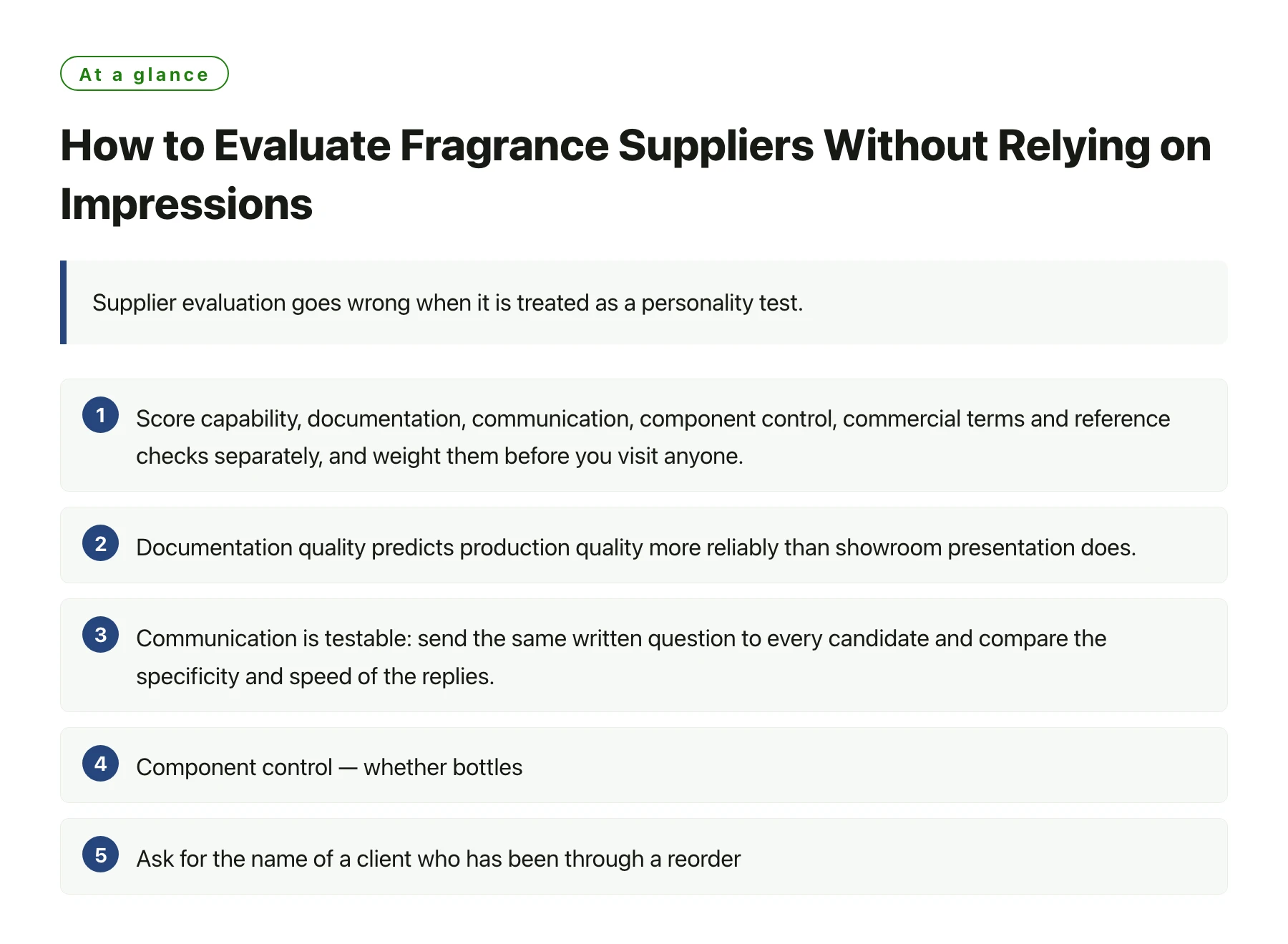
Key takeawaysScore capability, documentation, communication, component control, commercial terms and reference checks separately, and weight them before you visit anyone. · Documentation quality predicts production quality more reliably than showroom presentation does. · Communication is testable: send the same written question to every candidate and compare the specificity and speed of the replies. · Component control — whether bottles, caps and cartons are specified and held in house — determines how much interface risk you carry. · Ask for the name of a client who has been through a reorder, not just a first order, and expect to be given one.
Most buyers evaluate by visiting two or three factories, forming a view, and negotiating with the one they liked. That process selects for the ability to host a visit.
A scorecard does not remove judgement from the decision. It forces the judgement to be about defined things, and it produces a record you can revisit when the first order behaves differently from the pitch.
Six dimensions, and the evidence for each
The dimensions below are the ones that map to actual failure modes in a fragrance project. Weight them before the first visit, because weighting after the fact is how a decision becomes a rationalisation.
Give documentation and component control the heaviest weights for a first order. They are the two dimensions where a weak score reliably produces a problem later, and they are also the easiest to evidence objectively.
The scorecard
| Dimension | What good looks like | Evidence to request |
|---|---|---|
| Manufacturing capability | A clear written scope of what is done in house and what is not | A stage-by-stage scope sheet, not a brochure |
| Documentation and quality system | Batch records that can be walked from intake to release | One complete redacted batch record and the certificate scope; if the formula is built on restricted materials, the stated position should reference the published industry standards [3] |
| Communication | Written answers with specifics, within an agreed response time | The same brief sent to every candidate, compared line by line |
| Component control | Named specifications for bottle, closure, carton and decoration | A component specification sheet with colour references |
| Commercial terms | Explicit minimums, tooling ownership and payment schedule | A quote that separates one-off and recurring cost lines, plus a written answer on who holds any industrial design registration [2] |
| Reference depth | Clients who have reordered, in a comparable category | Two references and permission to ask about a repeat order — the same posture a house like www.xuelei.com takes when it publishes its service scope and certification list for buyers to check against [4] |
Score each dimension one to five and multiply by the weight you set in advance. The output is not a decision; it is a shortlist with reasons attached, which is what you want going into negotiation.
The tests that separate candidates quickly
Some checks produce a meaningful signal in minutes and cost almost nothing. Use them before spending a day on a factory tour.
Send the same written brief to everyone
A brief with a price band, a dosage range and a market will draw three different kinds of answer. One supplier will ask two or three clarifying questions that show it understood the technical constraints. One will respond quickly with a price and no questions. One will take a week and answer in generalities. The pattern is informative even before you visit.
This is also the cheapest way to test whether a supplier reads documents. If a written brief is answered with something that ignores half of it, the same will happen to a specification sheet later.
Ask to see one batch record
Certificates show that a management system was audited; a batch record shows what happened on a specific day. A cosmetics GMP framework such as ISO 22716 exists to make that traceability routine, and a supplier working to it will have the document available without preparation [1].
Read the record from raw material intake forward. Gaps early in the record — an unverified material, a missing weighing entry — matter more than a neat filling section, because they are where the traceability chain breaks.
Ask what is bought in
Every factory subcontracts something. The useful question is what, and whether the supplier says so without prompting. A plant organised as fragrance manufacturing under one roof will normally answer this in a single list covering compounding, filling, decoration, assembly and testing.
The answer changes your risk profile. If decoration is subcontracted, expect an additional lead-time buffer and a point of failure that your contact does not control directly.
Ask about the reorder, not the launch
First orders are treated well by almost everyone. The informative question is what happens on the third order: what the reorder minimum is, how quickly a repeat batch can be scheduled, and whether the formula or components may change between runs. A supplier that answers this precisely has a process; one that treats it as an odd question has a sales motion.
Red flags worth taking seriously
Individually, none of the following proves a supplier is wrong for you. Together, two or three of them are a reason to slow down.
A quote with no assumptions stated. A minimum order quantity that appears only after the sample is approved. Vague answers about who owns the tooling. A refusal to name the markets the company already exports to, expressed as confidentiality. A sales contact who cannot describe the production sequence without consulting someone else.
None of these is a character judgement. They are simply indicators that the commercial process is less defined than the manufacturing process, and an undefined commercial process is what turns a smooth sampling stage into a difficult bulk order.
One habit that improves every evaluation: write your conclusion the same day as the visit, in three sentences — what the supplier demonstrated, what remained unverified, and what would change your mind. Impressions blur within a week, and the unverified list is the agenda for the next conversation. If you want a structured version of the same exercise before you visit anyone, the notes on Xuelei's guide cover the checks in a similar order.
Sources
- SGS: Cosmetics, Personal Care & Household Testing —— Testing, inspection and certification services for cosmetics and personal care, including microbiological, stability and safety testing aligned with cosmetics GMP.
- WIPO — World Intellectual Property Organization —— The UN agency for intellectual property; resources on industrial design and patent protection relevant to product and packaging design.
- IFRA: Safe Use and Fragrance Science —— IFRA's explanation of how fragrance materials are scientifically assessed for safe use and how those conclusions are applied by the industry.
- European Commission: Cosmetic Products — Specific Topics —— EU pages covering specific cosmetics topics such as product claims, nanomaterials and animal-testing rules.
Frequently asked questions
How many fragrance suppliers should I evaluate?
Three is usually enough to see how the market answers the same brief and few enough to keep the comparison disciplined. More than four rarely adds new information and spreads your attention.
Should I always visit the factory?
A visit is valuable for the production areas you can see and the questions it prompts, but it is not a substitute for documents. A supplier that cannot show a batch record during a visit is unlikely to produce one afterwards.
How do I verify a certification claim?
Ask for the certificate number, the issuing body and the scope of the certification, then check with the issuing body directly. A certification list is the start of a conversation, not the end of an audit.
What is the most common mistake buyers make in evaluation?
Weighting price too early. Price is an output of scope, dosage, components and quantity, so comparing prices before those are fixed compares different products rather than different suppliers.
Should I ask for client references?
Yes, and ask specifically for a client in a comparable category who has placed a repeat order. A reference who only completed a first order cannot tell you much about reliability at scale.